

The Federal Reserve Bank of Kansas City’s annual Economic Policy Symposium in Jackson Hole, Wyoming, is one of the longest-standing central banking conferences in the world, drawing top economists from central banks, academia, and government institutions from around the world to discuss some the most challenging and important topics officials are facing today.
Enter Darrell Duffie, a highly respected professor of Finance and Economics at Stanford’s Graduate School of Business. Under the umbrella of this year’s theme, “Financial Innovation: Implications for Payments and Policy,” he has dived into one of the hottest topics on the agenda: “Tokenized Finance and The Perimeter of Central Banking.”
Darrel is known for taking topics that can be tough for people who have not studied what can be very technical financial issues and making them comprehensible. So, I start by asking him what is a token, why is tokenized money getting so popular, what does it mean for central banks and he dives right in.
”Well, we’ve been using electronic money for decades. When you use your bank account, you’re using digital money. Okay? And tokenized money is just digital money. It’s stored on a different kind of ledger,” he says. “But that’s just software. What really matters is what it can do that we couldn’t already do with traditional bank account money.”
Duffie clarifies that tokenized money is not a radical departure from existing digital money, but rather a new form of storing and transferring value. “We’ve been using electronic money for decades. When you use your bank account, you’re using digital money. Okay?
”And tokenized money is just digital money. It’s stored on a different kind of ledger. But that’s just software. What really matters is what it can do… That we couldn’t already do with traditional bank account money.”
The key innovation lies in programmability and the ability to make payments around the clock, features that traditional banking systems do not fully support. Darrell points to examples like JP Morgan Coin and the European Central Bank’s tokenized reserves, which enable programmable payments and 24/7 settlement, distinguishing them from decentralized cryptocurrencies like Bitcoin.
Duffie addresses the potential impact of tokenized finance on the Federal Reserve’s operations, particularly its balance sheet, noting that the coexistence of traditional and tokenized forms of money could lead to fragmentation, increasing the total demand for central bank money.
“Fragmentation across different types of money, meaning traditional money and tokenized money could mean that if banks and other market participants have to load up money in two different systems, they’re going to need more money in total,” he says. “That’s called fragmentation cost. And that’ll be expensive. And central banks will accommodate that.”
”They’ll have to grow their balance sheets if that happens in order to supply the quantity of money, central bank money that banks feel that they need.” However, Duffie also highlights that programmability could allow for more efficient liquidity management, potentially reducing the need for large balances over time.
Wait a minute. Isn’t the size of the Fed’s balance already a contentious issue, as Fed Chair Kevin Warsh has argued that Fed should reduce it and some other current and former Fed officials have opposed this?
“That’s on the negative direction, meaning bad news for those that want to reduce their balance sheets,” he says. Darrell says that while tokenization may initially increase the Fed’s balance sheet, greater efficiency could ultimately allow for a reduction, aligning with the goals of policymakers like Warsh.
Looking ahead, Darrell is cautious but optimistic about the integration of tokenized finance into mainstream financial markets. He emphasizes that the transition will be gradual and that traditional financial institutions are likely to favor tightly controlled, permissioned systems over fully decentralized models.
Spoiler alert: he says not everyone is going to want to do this.
”I think for the next years, traditional financial market participants are going to not want to use a totally decentralized system. They’re going to want it to be strapped down and authorized by a very small number of allocators.” This pragmatic approach reflects both the opportunities and the regulatory, operational, and security challenges that lie ahead for central banks and the broader financial system.
Tokenized Finance Is Based on Digitized Money 00:01:02:01
Sure. Happy to do that. Well, we’ve been using electronic money for decades. When you use your bank account, you’re using digital money. Okay? And tokenized money is just digital money. It’s stored on a different kind of ledger. But that’s just software. What really matters is what it can do that we couldn’t already do with traditional bank account money.
Thinking About What We Should Be Thinking About 00:01:23:11
All right. And what should central banks be thinking about when they see a world coming forward, in which financial market participants are going to be using these new, tokenized forms of financial instruments, like Treasury securities that are stored on what is known as a blockchain or a programable ledger.
Best Known of These New Vehicles: Bitcoin! 00:01:57:14
Okay, well, the most famous innovation in this whole sphere is what is known as Bitcoin. Yes. Which is a very decentralized form of tokenized money. It was invented by a fictitious named individual whom nobody knows for sure, but that is that fictitious name is Satoshi Nakamoto. And there’s a beautiful nine-page mathematics paper that describes exactly what this is.
But this Conference Is NOT About Bitcoin 00:02:31:08
And it continues, to this day, to be the most prominent form of cryptocurrency. However, what we’re talking about here at the Jackson Hole Symposium is nothing like Bitcoin. We’re talking about what J.P. Morgan Coin is, or what the European Central Bank is developing as tokenized reserves of the European Central Bank, which will look nothing like Bitcoin.
What Are These Things? 00:03:06:10
Well if you had a bank account at Chase, I don’t know if you do. You can ask for it now in two flavors. One is traditional checking account, and another is an account in which you can pay others with a tokenized form of JP Morgan bank accounts that will allow you to do programable payments and to make payments around the clock seven days a week -- what you cannot do with your current banking account unless you have a tokenized one already.
What is the ECB plan? 00:03:40:23
That will mean that the money that is deposited at the European Central Bank by European banks, which is called conventional reserves, those banks will be allowed to choose a different form of deposit called tokenized reserves, which again have the property that you can program <them>. Use software to make your payments contingent on whatever software commands you choose within reason, and also to make those payments 24 - 7 around the clock.
An Example Using Time-zones 00:04:37:03
Let’s suppose that it’s 9 a.m. Monday morning in Tokyo. And you want to do debt financing for some Japanese government bonds. And you want your financing in euros from a Parisian bank. Okay. So how could you do that? Because 9 a.m. Monday morning in Tokyo is Sunday afternoon in Paris. Now, what you could do is ask the Parisian bank if they have tokenized reserves and whether they could take those tokenized reserves and pay them to your clearing bank, which might be in London or Frankfurt or Tokyo. And the answer is in the future, if the European Central Bank is successful with this project, which is called Project Apia, okay, then yes, you’ll be able to do that even though it’s Sunday night, and you might even be able to do it in a programable way, meaning you won’t do it unless your purchase of those Japanese government bonds is successful on a different blockchain.
Limits to Account Directions, Contingencies 00:06:13:19
Okay. So, while you’ll be able to make one trade contingent on another trade that’s called ‘composability’ by the financial engineers that are doing this, you won’t be able to make your trade contingent on what governor of the Bank of Japan states in his speech, at least for the next few decades, that kind of contingency is not going to be in the software, doesn’t rule it out eventually. By the way, these kinds of external inputs to the system are called ‘oracles.’ And those oracles don’t exist yet. Now.
The Nature of Allowable Oracles Could Change 00:06:51:05
That an oracle today… an oracle could be that the price of the Japanese yen, as recorded on the Reuters trading screen, exceeds, you know, ¥150 per dollar. And that kind of oracle exists today. But those are external inputs to a programable ledger right now. Even that is not running in financial markets.
Lurking Cyber Risk 00:07:35:17
Well, one of the big issues that’s been raised here at the Jackson Hole Symposium both days has been cyber risk. And what do these new forms of programable ledgers do in terms of either increasing or reducing cyber risk? I’m always asked that question, yesterday during my presentation, and I responded that we don’t know yet, but there are both costs and benefits.
Costs and Benefits 00:08:01:04
A benefit is that because these new systems are often run on distributed ledgers, meaning the record of what’s happening is kept in many different places on the internet, that you have some resilience. The system is always on. It’s very hard to bring down the entire internet. So, that’s that gives you a plus on cyber resilience. But on the negative you’ve got more threat points; you’ve got more different pieces of software that are interacting at which there could be attacks or operational accidents that could bring down the system.
Bitcoin Has Displayed Vulnerabilities 00:08:39:13
And so it’s very early in the game. We don’t know yet, but there have been really problematic failures on the cyber front in cryptocurrency markets for things like Bitcoin, where the, you know, the resilience to cyber risk is not what it should be. And we assume that central banks won’t allow their programable ledgers to be very sensitive to these kinds of cyber-attacks.
Using the product…seamlessly 00:09:17:24
Right now, there’s been a lot of discussion at the retail level, which is not my focus, but on the on the issue of agenda payments, payment. Yeah. Let me unpack that. We’re here in Jackson Hole. Yes. Where is your next stop? Kathleen: My next stop is the airport. Darrell: After this airport, which airport are you going to land in? Kathleen: Going to LAX so I can get to SeaTac. Darrell: Okay, so let’s suppose that you didn’t have a ticket yet. And you’re in a hurry. And in any case, you don’t like to fuss with the internet and figuring out how to plug in your visa account details and selecting a flight. It won’t be that long before you’ll be able to tap Siri on your iPhone or Gemini on your Android phone… and say Siri, I am. I would like to go to LAX tomorrow morning between nine and noon. I’d rather not connect and I’d rather not pay more than $500. What’s on offer? And then Siri will respond. There are two flights, one on American, one on United. Which would you like? The former is $300; the latter is $500. And you’re going to say, Siri, buy me the United flight and that’ll be it. You won’t need to type anything. Reach for your credentials. Tap in your visa card. It’ll all be done for you. And in the future. Some suggest that this will be done also using blockchain-based payment systems.
Or maybe not quite that smooth… 00:10:59:13
Now, I am not completely buying that yet because…because I think the banks and the credit card companies are going to realize that threat, and they’re going to re-engineer their systems so that it will be more attractive for customers and businesses to continue to use traditional banking services. Now, that’s not to say that 50 years from now, traditional banking services won’t be entirely on programable ledgers. So that’s a different thing.
Vulnerability is untested and unknown 00:11:42:11
Yeah. So that issue also came up here at the symposium, whether there could be a sudden stop in financial markets if everything is on some kind of ledger, a ledger system that’s not robust, or the money that’s being used on that system is not robust. Right now, it’s too early to say that these new kinds of systems are more vulnerable or less vulnerable.
How Transactions Will Likely Develop 00:12:04:19
And so, I’m, you know, I’m not going to opine on that. I will say, though, that when we use the term blockchain here and I use it as well, we’re actually talking about a very wide range of types of software platforms, which go everything from the kind of block chain that’s used for Bitcoin, which is very decentralized. And there are literally a chain of blocks that are validated by many nodes on the internet to a system that’s very tightly controlled by a small number of actors. That’s not a chain of blocks, it’s simply a traditional ledger that’s been re-engineered to do programing, to do software. So everything in between is what tokenized finance might be. And I think for the next years, traditional financial market participants are going to not want to use a totally decentralized system. They’re going to want it to be strapped down and authorized by a very small number of operators.
Issues of Privacy and Compliance 00:13:13:16
Yeah. There’s also issues of privacy and compliance. They don’t want to get in trouble with AML. They don’t want to have issues with their credentials leaking or their private trades being revealed. And that’s more easily done today, at least on more tightly permissioned and authorized programable ledgers.
Any Fed Balance Sheet Impact Here? Fragmentation… 00:13:59:15
Yeah. Well, you ask a very intuitive question. And another one that came up in the symposium, what are the implications for the size of the central bank’s balance sheet? And I analyzed that in my Jackson Hole symposium paper in a model, of course, and found that it could go both ways. ‘Fragmentation’ across different types of money, meaning traditional money and tokenized money could mean that if banks and other market participants have to load up money in two different systems, they’re going to need more money in total.
Fragmentation Cost 00:14:33:16
That’s called fragmentation cost. Okay. And that’ll be expensive. And central banks will accommodate that. They’ll have to grow their balance sheets if that happens in order to supply the quantity of money, central bank money that banks feel that they need. The demand could go up. Now that’s in the negative direction, meaning bad news for those that want to reduce their central banks, like the current chair of the Fed.
And, There Are Savings Possibilities, Too 00:14:58:08
Kevin Warsh, on the good side, because of this feature of programmability, you’ll be able to program how frequently you refund the money in your central bank account, and so you won’t need to procure for the whole day. You can procure every hour, and that means the total amount that you need in your central bank account will be smaller, and that’s based on more frequent funding.
Already Some Tokenized Savings Are Being Exploited 00:15:25:22
And we’re already seeing evidence of that in the tokenized market. One firm called Broderick is providing $8 trillion a month of intraday funding for the very largest banks so that they can reduce the amount of money that they need to meet their business needs. It happens that the reasons for that are largely regulatory, and also that these intraday funding transactions are typically between two affiliates of the same bank holding company, the securities dealer and the commercial bank. So it’s not the genuine article with respect to broad spread funding markets being intraday, but it’s a sign that this could happen and reduce the need for money.
Unclear what the monetary impact might be or if task forces are even looking into it 00:16:40:17
Well, the Fed chair has impaneled a task force on the Fed’s balance sheet. And so, if we’re talking about implications for balance sheet. Yeah, there’s… I just mentioned that tokenization could initially increase the need for the Fed to increase its balance sheet size… but eventually could reduce it so that I don’t know if that will figure into the current analysis of the task force that that chair Warsh set up to analyze this. It need not, because this is coming, not in the next year or two. It’s going to come in the next 5- to 10-years.
What is going on to influence balance sheet size? 00:17:28:04
So, this is not related directly to tokenization.
Two Sides to the Balance Sheet Reduction Problem 00:17:35:10
…in my view there’s two sides to the Fed’s balance sheet. There’s the assets and the liabilities. And there are different things to do on each side. Let’s talk about the assets first. There’s a composition issue here. How much of Treasury bills does the Fed want to hold on its balance sheet? How much of longer term Treasury securities called notes does it want to hold on its balance sheet? And then how much mortgage backed securities, which are government agency securities? And I have a pretty clear prediction of what the Fed probably wants to do. I don’t know what the task force will recommend, but I’m guessing the Fed will not be buying more mortgage-backed securities. They’ll just let the ones that they have mature. I’m guessing that they will allow a lot of the notes, the longer-term securities, to mature and not replace them with longer term notes, but rather replace a lot of those with Treasury bills.
Why Reduce Holdings of Long Term Assets? 00:18:35:01
And why do I predict that? Because the Fed, rightly or wrongly, has been criticized for having a volatile net interest income, meaning some years, like in the last few, it’s been losing a lot of money. In some years it gets a lot of money, it makes a lot of money. You could say this is not consequential, because it ends up giving all of those profits and losses to the Treasury Department anyway, making it a wash.
Narrowing Asset & Liability Maturity Stabilizes Net Interest Income 00:19:06:09
However, if the Fed is sensitive to this criticism, having a lot of Treasury bills to match the reserves on which it pays interest to banks means that it’s that interest expense will be very low and not very volatile, because every time the Fed increases the interest rate that it pays to banks, it will be getting more interest income on its treasury bills, about one for one.
Headed For Maturity Matching! 00:19:36:03
So that’s a policy that I would predict the Fed is heading towards, which is matching the quantity of reserves, which is now about 3 trillion, with the quantity of Treasury bills that it holds. So that’s everything that I have on the asset side.
The Liability Side 00:20:10:13
So on the liability side the Fed is providing services to the economy with its liabilities. It’s providing a service to the Treasury Department. It allows the Treasury Department to have an account there that’s providing services to Americans in the form of paper money. And it provides services to banks in the form of allowing them to store reserves at the Fed, to make their payments and to meet their liquidity needs. And it’s going to be very difficult with the Fed’s current framework to reduce any of these services that it provides to the economy. If it can’t reduce its liabilities, then it can’t reduce its assets, because first lesson of corporate finance assets equals liabilities. So if the Fed really wants to reduce its balance sheet, it’s going to have to change the way that it regulates banks and compensates them for its reserves and manages the payment system.
See Brookings Paper! 00:21:07:21
And that’s the subject of a Brookings paper I wrote earlier this year. I think you mentioned. Link(Duffie, Brookings
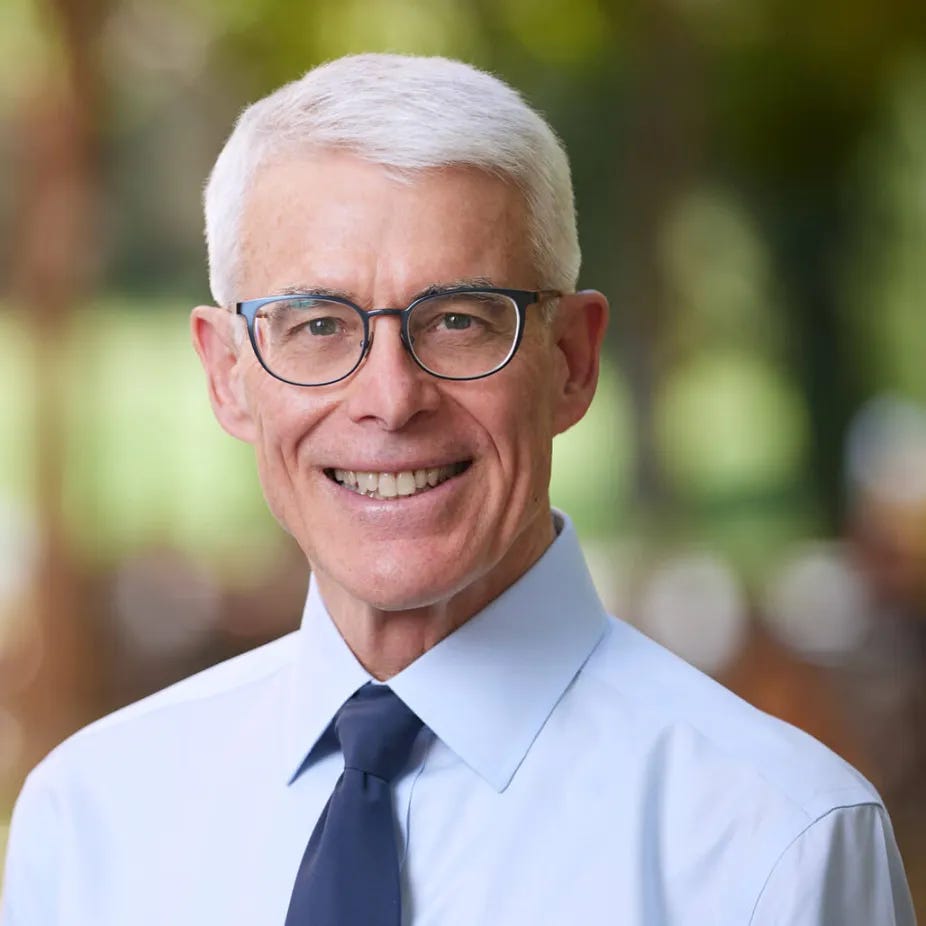
Darrell Duffie
Darrell Duffie is The Adams Distinguished Professor of Management and Professor of Finance at Stanford University’s Graduate School of Business. He is a Research Fellow of the National Bureau of Economic Research and a Fellow of the American Academy of Arts and Sciences. Duffie is a past president of the American Finance Association and chaired the Financial Stability Board’s Market Participants Group on Reference Rate Reform. He is an independent director of the Dimensional Funds and a member of the leadership teams of the G30 Working Groups chaired by Tim Geithner on Treasury Market Liquidity and chaired by Bill Dudley on Bank Failures and Contagion: Lender of Last Resort, Liquidity, and Risk Management. Duffie’s most recent book is Fragmenting Markets: Post-Crisis Bank Regulations and Financial Market Liquidity, DeGruyter, 2022. In 2024, Duffie is teaching a new course at Stanford, “The Future of Money and Payments.”


