

Esther George was president of the Federal Reserve Bank of Kansas City from 2011 to 2023. Yes, the same Fed district bank that has been hosting the annaul Jackson Lake Lodge policy conference for 49 years which has risent to become the most imporant central bank conference in the U.S, if not in the entire world.
She joins me as the new Fed Chair Kevin Warsh just has delivered opening remarks at the K.C. Fed’s 49th annual conferenence against the backdrop of the economic and financial world that has been waiting eagerly to see what he has to say about where monetary policy is now and where he expects to drive it next.
“I thought what he did well today was to articulate the focus on inflation and he gave his own assessment of the economy,” she says. “ And he laid out principles in a way that I think led you to understand where the focus might be for the Federal Open Market Committee as they think about the work of the task force and other things.”
Esther’s own approach to monetary policy which notably is pragmatic and data-driven cautions against excessive delay in responding to inflation. “So, you know, I think stability is important. And you can say that on many levels, whatever changes the Fed’s going to do, I think people need to understand that the central bank is going to be independent in its decisions, and that its number-one job right now is to bring price stability to the economy.”
”And I hear the words and I’m encouraged by the words, but I think at some point you have to act relative to that. So I would encourage him to say, don’t wait too long. Don’t keep looking for more and more data,” she says. “I would be responding sooner rather than later, and it doesn’t mean you have to do a 100 basis point, you know, run up in rates,”
“I thought what he did well today was to articulate the focus on inflation and he gave his own assessment of the economy. And he laid out principles in a way that I think led you to understand where the focus might be for the committee as they think about the work of the task force and other things.”
Esther cautions against excessive delay in responding to inflation after Warsh has said the Fed’s number one job right now is to bring price stability to the economy. “I hear the words and I’m encouraged by the words, but I think at some point you have to act relative to that,” she says.
On fiscal policy, George is forthright about the dangers of rising deficits and the limits of monetary policy in addressing them. “Well I think having heard and watched this idea that we’re on an unsustainable path with our fiscal policy, our deficits are growing,” she says. “The interest on that debt is creating real problems. It’s not surprising to me that you would see elevated long term yields.
”Are there other things that are at play there?,” she asks and then answers. “There’s everything from the fiscal discipline we lack right now to the amount of capital that is being demanded for this AI and the data centers, all of that build out. And so those rates are going up. That’s not something the Fed can fix. That’s something our Congress really has to step in and do.”
Warsh: A Good speech…Filled in Some Gaps 00:01:21:20
I thought it was a good speech. I thought it was responsive to some of the concerns that had bubbled up after the July press conference about we don’t understand what, you know, what was the reaction function. You heard all the concerns. I thought what he did well today was to articulate the focus on inflation and why he gave his own assessment of the economy.
Listed Principles 00:01:46:13
And he laid out principles in a way that I think led you to understand where the focus might be for the committee as they think about the work of the task force and other things. So let’s talk about.
Pledges Discipline Not Giving Directions 00:02:17:18
So the one takeaway I took from him articulating the principles, and I think he closed with this, is to say you can count on us for the discipline, but not the decision when we talk about where we are. And so those principles really laid out the discipline of we’re going to be looking at what drives the economy. We’re going to be thinking about what is driving inflation, what our job is around that. And so I think, again, some of those weren’t new statements to the public, but I think he really gave more contours, for example, to inflation.
Warsh Used Pejorative Words to Describe the Inflation Situation 00:02:54:14
So he used words like it’s concerning. We are looking at the trend as opposed to near term, even when it’s far to say when I go through the basket, what percentage of the items that give you a sense of how broad it is? And so I thought those were important. Those are the kinds of things, in my experience, they would talk about and try to understand how concerned they should be when looking at our inflation data?
Fed Chairs Get - Not a Honeymoon- But a Test 00:03:54:12
So I think it’s all of those things, Kathleen, and you might expect this anyway of a new fed chair coming in. There’s always the test. People are trying to figure out what will this Fed chair focus on. I think he came in by talking about things he wanted to change and people were trying to figure out. Are you changing the target?
What Are You Changing, and Why? Today Hit the ‘Why’ Hard. 00:04:13:23
Are you changing the measurements? Kind of how broad is the change you’re looking at? So I think and coming off again, that last press conference, which again people were wondering, why didn’t you raise rates? I think we saw in the minutes some rationale for that. But I thought today was really it really hit the mark in terms of saying, here’s how I think about inflation, here’s how I assess the economy.
…And He stopped Short of Giving Any Guidance 00:04:41:17
It’s a strong and growing economy. And again, stopping short of saying, here’s what I’ll do in September, which I think is probably exactly the right thing to do. But laying out what is the thing I’m focused on. So I think that could be exactly right. And that’s why I think stopping short of saying what you were doing is true to his message of I’m not going to give what we’re guidance. I’m not going to lead the market. I’m going to tell you what I’m concerned about today. I’m going to say inflation is a problem that we have to keep our eye on, and there is more data to come.
I would NOT Be 100% Sure there will Be a Rate Hike in Sept- 00:05:53:05
So, you know, I wouldn’t put 100% in the camp of saying, oh, that meant a rate hike is coming. I’d like to see that. I think you could justify it already, but I think he left the door open for an estimate, a next set of data they want to look at, and we’ll see.
Even anchoring can be fickle… 00:06:30:03
Well, I think the data I would have seen by now, going back to the June July meeting, would have said this is persistent inflation and it’s remained above target a long time. And I worry too much about emphasis on inflation expectations being well anchored, which we heard again today, a sense that there will anchored. But those can be temporary.
Room to move…Need to move? 00:06:53:23
And so I would be leaning in the direction of saying unless there is new information, there’s certainly be more information. But unless it was really new and told me something different than the trend, I think I’d be in the camp of saying, we need to move.
Is Policy Restrictive?? No! 00:07:37:02
Yeah I mean I understand that I understand people not wanting to get ahead. But the truth is if you’ve seen what you’ve seen and nothing changes, then I think you have to. And I thought I heard that today in the chairman’s speech, which is it’s hard to believe this policy is restrictive < Note:Warsh said that only In agriculture and in housing is policy restrictive noting... “I would be hard pressed to describe broad financial conditions as restrictive.”>.
Performance Suggests Rates ae Not Restrictive- 00:08:13:04
…And I think the evidence taking aside the supply shocks the around war. That inflation rate has hung in there well above target long enough to say it ought to raise a question. I think about the restrictiveness.
Task Forces are a Good Idea 00:08:49:00
I think it is something the Fed should be doing. I think it would. It’s a good exercise for any institution, whether you’re a reserve bank, you’re the central bank. To really take a look at what are the assumptions you’ve made? How has the world changed? What should you be looking at around that. And so I think it’s a really healthy thing to do right now.
…And Hopeful About Getting Some Good Results 00:09:08:11
Are those are the right five? I don’t know. There’s some good ones. The balance sheet I think is a good one. Inflation dynamics. Thinking about this issue of productivity, this committee is going to really have to decide is that a long term thing? Is it a near term thing that we’re looking at. So I’m hopeful that that the people they put on these task forces, which seem well qualified to look at these issues, come up with some work that really will give the committee something to talk about and think about.
Central Banking Plumbing Matters- 00:09:56:21
I was really glad to see this topic because, you know, Kathleen, I spent some time at the Fed thinking about the payment system or what I call the plumbing of our financial system. And it’s often in that plumbing where things can break, can hiccup. That brings central banks to the fore. So I think to talk today about what is changing in that landscape.
The Conference Papers Did Address The Issues 00:10:19:12
So it is everything from AI to these digital assets, cryptocurrency, stablecoins, blockchain ledgers that both have promise. I think they’re certainly being deployed now. But thinking about what does it mean if you’re a central bank and you provide this public good called payment rails, a backstop to the banking system. And I thought the papers that we heard today really hit on the issues of, yes, innovation.And we should try to find innovation that serves the public. But we have to think about what does it mean when we have to step in and underwrite. Is there one.
Hiking Transaction Speed May Be Good But it Also Raises Risk 00:11:17:03
When you’re creating these blockchain ledgers, these are what they call decentralized. I mean, there’s not a central authority and the speed is the other thing. I think the interconnection when you’re going fast same on a highway. Right. The risk goes up in terms of - can you be compromised? And that affects more endpoints to that. So again it’s not always popular for central banks to talk about this.
The Central Bank Needs to Understand how it all works 00:11:46:12
It sounds heavy handed. You don’t want to throw sand in the gears as someone said today. But I think it is so important that we understand. What does it mean? What does it mean for how we transmit our policy if you’re not using the banking system through that? So good discussion. I thought.
Many Challenges Ahead 00:12:25:19
Yeah. Well I think having heard and watched this idea that we’re on an unsustainable path with our fiscal policy, our deficits are growing. The interest on that debt is creating real problems. It’s not surprising to me that you would see elevated long term yields. Are there other things that are at play there? I’m sure there are… There’s everything from the fiscal discipline we lack right now to the amount of capital that is being demanded for this AI and the data centers, all of that build out.
Things Can Get Beyond the Fed’s Control 00:13:01:10
And so those rates are going up. That’s not something the Fed can fix. That’s something our Congress really has to step in and do. And I think it’s beginning to get more attention in the media. I think the public is starting to look at this to say what is what is the fix for that?
Are Banks Carrying Unexpected Risks? 00:14:04:01
You know, the number one thing you always look for is, is the bank holding enough capital relative to the risk they’re taking. And right now, on the credit side is a good time to be looking at borrowers that may have taken on interest rates that they might not have assumed would carry on this long of a repricing at a point.
A Typical Characteristic of Commercial Real Estate 00:14:25:11
This is always true with commercial real estate, for example. Once the terms are up, can this thing continue to cash flow at higher rates? So I think in the banking system generally, you are always looking at credit risk relative to the capital of the bank. And as you know, a lot of our credit extension has moved outside the regulated banking system and to private credit.
Events Are Happening Outside the Banking System 00:14:47:09
And we’re beginning to see in some cases, some of those deals begin to pop up in terms of counting on the time frames at which they’d have to pay these rates. So and there’s less insight to how that’s working.
Private Credit is Connected with Banking Sector Credit 00:15:19:14
So when I look at private credit Kathleen, it’s not so much the absolute size of it relative to total credit in the economy. It’s the interconnectedness. So that part of the financial system is relying heavily on the banking system to provide lines of credit, to provide liquidity to them. And when you get that kind of interconnectedness, the transmission of any kind of contagion or scares or repricing of those assets, if rates stay high and you have to reprice the deal that it’s underwriting, that’s when you can get some spillovers to that.
Strong Capital Is a Safeguard 00:15:56:21
So it doesn’t mean it’s imminent. And it reminds me, you know, we could have and did see deals ahead of the mortgage crisis. That didn’t make sense. But nothing bad was happening right now. So that’s why I think at the end of the day, having strong capital in these banks is really your safeguard and allows the cycle to move and banks to be able to withstand them.
Stability is Important 00:16:40:21
So, you know, I think stability is important. And you can say that on many levels, whatever changes the Fed’s going to do, I think people need to understand that the central bank is going to be independent in its decisions, and that its number one job right now is to bring price stability to the economy. And I hear the words and I’m encouraged by the words, but I think at some point you have to act relative to that.
Advice: Do Not Wait Too Long or Require Too Much Proof To Act 00:17:10:01
So I would encourage him to say, don’t wait too long. Don’t keep looking for more and more data. I would be responding sooner rather than later, and it doesn’t mean you have to do a 100 basis point, you know, run up in rates. But I think you have to follow up your commitment with some action.
Many Jackson Hole Memories 00:17:33:24
Well, I kind of can been involved in the planning for many years. We were talking yesterday. My first Jackson Hole was in 2005. I was the head of supervision, and it was the Greenspan era, right where we were recognizing, you know, what had happened during his two decades of leading the Fed. And every year has something interesting, whether it was from having to go online during the Covid time, whether it was years that the center for Popular Democracy brought people out here and wanted to talk to Fed officials. Oh, yeah, about the labor market. But I think one thing has remained true. People come here to have the relationships, to talk about the issues, and I hope that continues and I’ll look forward to next year.
———————————————————————
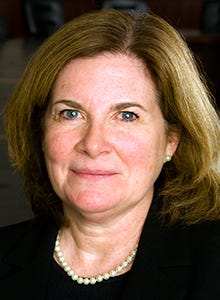
Esther L. George
Esther L. George was president and chief executive officer of the Federal Reserve Bank of Kansas City from October 11, 2011 to January 31, 2023.
George was born in St. Joseph, Missouri, and grew up on her family’s farm in nearby Faucett. She holds a bachelor’s degree in business administration from Missouri Western State University and a master’s in business administration from the University of Missouri-Kansas City. She is also a graduate of the American Bankers Association Stonier Graduate School of Banking and the Stanford University Executive Program.
George joined the Kansas City Fed in 1982 and was appointed to the official staff in 1995. She has held various leadership positions with the Bank, including in the Bank’s research support functions, Public Affairs and Human Resources.
Before being appointed president on October 1, 2011, George had been the Kansas City Fed’s first vice president and chief operating officer since August 2009, where she was responsible for directing the Bank’s operations throughout the Tenth Federal Reserve District. Additionally, she has served as the acting director of the Federal Reserve’s Division of Banking Supervision and Regulation at the Board of Governors of the Federal Reserve System in Washington, DC.
In January 2009, George was named executive vice president in charge of the Kansas City Fed’s Division of Supervision and Risk Management, a division she led as senior vice president since 2001. In that position, she was responsible for the supervision and regulation of the Tenth District’s 170 state-chartered member banks and nearly 1,000 bank and financial holding companies, as well as the Bank’s discount window and risk management functions. During her tenure in banking supervision, she was directly involved in the banking supervision and discount window lending activities during the banking crisis of the 1980s and post-9/11. She is a former chair of the Federal Reserve System’s Community Banking Organizations Management Group.
Beyond the Tenth Federal Reserve District, George’s experience in international central banking issues includes involvement with the Bank for International Settlement’s Financial Stability Institute programs in Lima, Peru, and Abu Dhabi, United Arab Emirates. She has also served as the Tenth District’s lead officer for international partnership programs involving the central banks of Morocco and Iraq. Additionally, she hosts the Kansas City Fed’s annual economic policy symposium in Jackson Hole, Wyoming, that is attended by central bankers from around the globe.
George retired in January 2023 after reaching the mandatory retirement age for Reserve Bank presidents.


