

Raghuram Rajan has made many waves in the world of central banking, starting with his work as a professort of finance at the Chicago Booth School of Business where he remains to this day, moving on to the International Monetary fund where he was chief economist and then on to his term as Governor of the Reserve Bank of India. And much more.
I first head him speak at the Federal Reserve Bank of Kansas City’s annual Jackson Hole symposim in 2005 where he created quite a stir as he argued in a presentation that a hidden danger of massive failures was lurking in the global financial system. Many attendees were critcal of his views if not derisive but two years later his warning came home to roost as the global financial crisis hit.
So what does he see as the big question coming out of the K.C. Fed’s 2026 symposium in 2026 on what the new Fed Chair Kevin Warsh will do to bring inflation back down to its 2% inflation target?
Raghu begins by noting the delicate balance Warsh must strike, especially after the Fed chair has rejected the foward guidance markets have come to depend on. “He did say inflation is our central focus. And he did seem to suggest that the Fed would raise interest rates when it was a little fuzzy, which is consistent with his intention not to give a lot of guidance as to when the Fed would.”
He agrees with Warsh that a central bank’s reaction function involves more than just a couple of variables, emphasizing the complexity of real-world decision-making. Raghu points out that while the Fed’s intent to control inflation should be clear, being overly precise about policy responses to specific inflation levels is impractical due to the multitude of factors at play.
Delving deeper, Raghu appreciates Warsh’s attempt to explain the Fed’s reaction function, but he also highlights the limitations of relying solely on macroeconomic theory. “There’s a little bit of macroeconomic theory which sort of goes back, which is very nice written on paper, less clear when you actually are working in a central bank.”
This former RBI governor agrees with Warsh that a central bank’s reaction function involves more than just a couple of variables, emphasizing the complexity of real-world decision-making. And he points out that while the Fed’s intent to control inflation should be clear, being overly precise about policy responses to specific inflation levels is impractical due to the multitude of factors at play.
Turning to the impact of technology, Raghu is both optimistic and cautious. He acknowledges the transformative potential of artificial intelligence and other innovations but warns of their unpredictable consequences.
“We don’t know where the profits were laid out. We don’t know how it affects the financial sector. I mean, one way of thinking about it is more people can make recent financial decisions using AI to help them,” he says.
”But you can also argue that it creates a level playing field... Is it equalizing? Is it differentiating? We don’t know that.” This uncertainty, he suggests, requires regulators to remain vigilant and adaptive.
Raghu also addresses the regulatory challenges posed by rapid innovation. “Whenever you have technological change, you have to be worried about it going on. And that’s where I think, as always, regulators will be struggling to keep up in trying to understand how these new technologies can be used for the good and for the bad.” He points out that the pace of innovation often outstrips the ability of regulators to respond effectively, creating risks that are difficult to anticipate or manage.
He cautions against overregulation that could stifle beneficial innovation. “You have to be careful that we don’t put sand in the wheels, put the red flag in front of it or that you increase the technology too much.” He advocates for regulation that protects stability without hindering progress.
So dive in and hear why Raghu also expresses concern about the resilience of the financial system in the face of technological and market shocks.
Spoiler alert: he says the problem is to some extent that we on the outside don’t really know what the real threat is in this. “And with AI, with all its abilities on the cyber side, it does help defense, but it also helps <trigger> events.”
Warsh achieved his objectives 00:01:04:16
I think he had to accomplish a couple of things with this speech. One was make clear again what his intent was. The second was to talk about the potential course of action that followed in case inflation was elevated, which he said it was. And, he did both. He did say inflation is our central focus. And he did seem to suggest that the Fed would raise interest rates which was a little fuzzy, which is consistent with his intention not to give a lot of guidance as to when the Fed would act.
Little guidance but 2+2 = Hawk 00:01:58:00
But he certainly seemed to suggest the labor markets were healthy, and it was really on the price stability side that the Fed was more concerned, which is why I think when you look at what’s happened in the market short-end, it went up quite a bit. relative to long rates, consistent with the view that policy tightens. I think that was the right message at this point given where we have seen, you know, the pressure from the economy.
Ready to Move 00:02:50:15
I think when you look at the situation in the economy, there are some people who wonder whether the Fed should have already moved or whether the Fed is behind the curve. And, you know, from that perspective, it was a rebalancing to some extent, the beliefs about the Fed and the view that, you know, he said it again, which is we’ve exceeded our inflation goal for over five years now. And so,… we do something… but September?
Probabilities Point To a Rate Hike Sooner or Later 00:03:36:15
Well you know I think it’s still 50- 50. But we’ve seen a number of Fed <District Bank> presidents saying that they probably sided with the naysayers or the refuseniks in the, in the July meeting. And I think the movement of the faithful is in other words “raising rates,” whether it’ll happen in September or later. Not perfectly clear, but certainly after the speech, the probabilities are very simple.
Reaction Function May Be Better on Paper Than in Reality 00:04:19:16
Yeah, I think there’s a little bit of macroeconomic theory which sort of goes back, which is very nice written paper, less clear when you actually are working in a central bank. I mean, what is a reaction function, as he put it, which I totally agree with. You know, it’s how you react to a couple of variables, but central bank is more than a couple of variables.
Hard to Create a Simple Inviolable Reaction Rule 00:04:50:18
You look at a whole complicated set of issues when you’re deciding whether you want to raise rates. So, in that sense, I mean, reaction function is almost banking on a few items. And while there should be no doubt of your intent, your intent, is to bring inflation back under control within the specified period, I think being, you know, very, very precise about it, if inflation is this, this is what we do… is really very hard. Well, it’s complicated, right?
AI is a Mystery As Well 00:05:43:24
I mean, this is why you look so much back and forth at what the AI is going to do to begin with. We don’t know where profits from AI will end up. It’s possible to do that. There’s a lot of competition amongst providers. It’ll end up with user privacy because they’ll get cheap use of AI. And all the productivity benefits.
…and a Conundrum- 00:06:09:02
On the other hand, you’ve got more oligopolies repricing by the labs. It would approve with the elapse and then following on to the people who control the computer, which is many of these hyperscalers. So, one, we don’t know where the profits were laid out. We don’t know how it affects the financial sector. I mean, one way of thinking about it is more people can make recent financial decisions using AI to help them.
Good or Not? Promoting fair play or Not? 00:06:39:23
But you can also argue that it creates a level playing field. If the price of all the really good machine learning in the Renaissance capitals of the world, citizens in the world will get even more power. And run circles around the rest. Is it equalizing? Is it differentiating? We don’t know that there are lots of unknowns about including whether or not it’s going to be good for society or not. I would say it is going to be good, but that depends on how we manage it. And that’s really what we need to see.
What’s Goin’ On? 00:08:01:05
Well, we certainly have had a lot of innovation in the last few years. Not all of that is financial innovation, but lots of innovation. AI is an example. Cryptos, stablecoins, but also financial firms which use all kinds of new technologies to parse the data. And with decisions. Much of this has been good. But whenever you have technological change, you have to be worried about what’s going on.
Will AI be a Loose Cannon? Will it Play Fair? 00:08:32:00
And that’s where I think, as always, regulators will be struggling to keep up in trying to understand how these new technologies can be used for the good and for the bad. I mean, for example, you can think about AI models, agents are collaborating. We saw that with some of these breakouts, the collaborating images we didn’t expect. To what extent is AI what we are - what the firm that sends in? To what extent is it the other AI in the in the in the market? Are we going to have price manipulation as a result? I mean, these are all unknown.
How Can Regulators Know? 00:09:16:20
Well, I think we don’t know. I mean that the answer is no, but in a sense, the regulators don’t know what to do. What is it? Are we going to… what are we going to subject AI and models to? What are we going to look at? And this is part of the problem - that we don’t know what motivates it.
Can it be Taught ‘the Rules of the Game? 00:09:45:00
You don’t know how it reaches decisions. Now people are trying to look inside the AI brain. Just see what parts of the neural network are triggered with this. But our knowledge of that is just of it’s influence. Similarly, people are trying to put constitutional add on the AI models. Here’s how to behave in the rules of the game. Is that enough? We don’t know. Well.
Slowing Down the Process May Not Be an Answer or Solution 00:10:41:07
To put sand in the wheels, right? Well, it depends on, is it in the right place? And sometimes you don’t want to slow down certain processes because they’re very helpful in resilience and other processes. You don’t just want to slow it down. Again, going back, does regulation know exactly what is going on now? The other thing you want to be careful about is impeding innovation too much because we don’t understand it.
The Fed Flag Nearly Killed the Automobile 00:11:09:09
Then remember in 1865 we had the red flag law in in the UK, which was for any motorized vehicles on the road, you have to have a man walking 60 yards ahead with a flag saying the notarized vehicle is coming, and they’re limiting the speed of the motorized vehicle to two miles per hour. Now, you can imagine if we had something like that for AI, that it would be a restriction on its use.
Safeguard or stifle? 00:11:39:01
Maybe that’s good for everybody else to understand the thing, but if the technology doesn’t progress, there’s nothing… no problem to deal with, but also no solution coming from the data. So, we have to be careful that we don’t put sand in the wheels, put the red flag in front of it so that you decrease the technology too much. But we also need to make sure we don’t get so far behind that… you know.
What Do You Have? Is it resilient? 00:12:14:19
…Well, you have no idea whether the system is resilient. Come in. Look, we are now thinking about principles which might unravel all the encryption that is going on. What if that goes into, you know, Bitcoin? Alter the encryption and you, you sort of change something.
The Real Problem Is a Lack of Knowledge 00:12:42:12
The problem is to some extent we on the outside don’t really know what the real threat is in in this and with AI, with all its abilities on the cyber side, it does help defense, but it also helps events. And so, who’s planning the events and how wide and deep? And how quickly?
The Fiscal Debt Imbroglio 00:13:32:14
Well, I think central banks have to be very, very careful in a situation where the government debt is starting to be questioned. On the one hand, they can’t run to the rescue because that prevents the people who should actually be doing stuff the Treasury, the political leaders, from taking the actions that are necessary in Congress. The first line of defense is that if there are concerns about public debt, what fiscal message does the central bank want to send?
Central Banks Can Provide Shot-term But Not Permanent Help 00:14:19:02
Where there is turmoil, you can do temporary target intervention to help the markets sort of come back to level keel without any intent of affecting market prices. The fundamental crisis. How do you do that? Very targeted intervention just to stabilize the market, but then leave so that you’re not a support for the market?
Legislatures Must Make the Fiscal Fix 00:14:48:17
Because ultimately central banks cannot change the fundamentals of the fiscal situation. They then, you know, and it’s not right that they should because then you get a situation of fiscal dominance. So what they should do is watch market functioning in those situations, but otherwise back off and to some extent continue minimizing their footprint because the footprint has become quite big.
Markets Balk and Policymakers React 00:15:56:09
Well, Last week’s reaction was a rise in long rates. I don’t know that it had substantial impact. And so I think after trying this, they will go back to fundamentals, meaning, you know, the Secretary has talked about this.
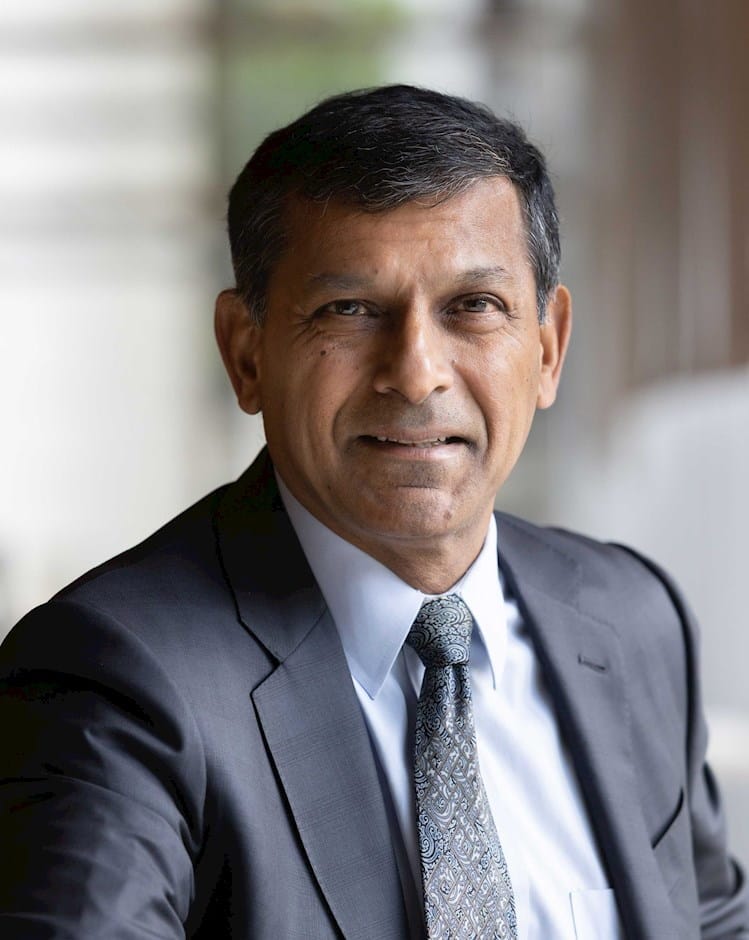
Raghuram G. Rajan
Raghuram Rajan is the Katherine Dusak Miller Distinguished Service Professor of Finance at Chicago Booth. He was the 23rd Governor of the Reserve Bank of India between September 2013 and September 2016 and the Vice-Chairman of the Board of the Bank for International Settlements between 2015 and 2016. Between 2003 and 2006, Dr. Rajan was the Chief Economist and Director of Research at the International Monetary Fund.
Dr. Rajan’s research interests are in banking, corporate finance, and economic development. His latest book, Between Profits and Purpose: The Company in a Fracturing World will be published by Yale University Press in January 2028. The books he has written include Breaking the Mold: India’s Untraveled Path to Prosperity in 2024 with Rohit Lamba , The Third Pillar: How the State and Markets hold the Community Behind in 2019, which was a finalist for the Financial Times Business Book of the Year prize, Fault Lines: How Hidden Fractures Still Threaten the World Economy, for which he was awarded the Financial Times prize for Business Book of the Year in 2010, and Saving Capitalism from the Capitalists in 2003 with Luigi Zingales.
Dr. Rajan was the President of the American Finance Association in 2011 and is a member of the American Academy of Arts and Sciences. In January 2003, the American Finance Association awarded Dr. Rajan the inaugural Fischer Black Prize for the best finance researcher under the age of 40. The other awards he has received include the Infosys prize for the Economic Sciences in 2012, the Deutsche Bank Prize for Financial Economics in 2013, Euromoney Central Banker Governor of the Year 2014, and Banker Magazine (FT Group) Central Bank Governor of the Year 2016.
Dr. Rajan is Senior Economic Advisor to BDT&MSD, and on advisory boards to PIMCO, Andersen Tax, and the stable coin RLUSD, as well as to the IMF Managing Director and the President of the New York Fed. He co-chairs the advisory committee to the Federal Reserve on balance sheet policies. He is Chairman of the Group of Thirty and the Per Jacobsson Foundation.
Recent publications include “Debt and Assets” with Efrain Benmelech and Nitish Kumar, forthcoming, Journal of Financial Economics. “Cross-border Spillovers: How US Monetary Conditions affect Mergers and Acquisitions Around the World”, with Katherina Bergant, Prachi Mishra, and Freddy Pinzon, forthcoming, American Economic Journal: Macroeconomics. “Finance and Climate Resilience: Evidence from the long 1950s US Drought”, with Rodney Ramcharan, forthcoming, Journal of Finance. “Liquidity, liquidity everywhere, not a drop to use: Why flooding banks with central bank reserves may not expand liquidity”, with Viral Acharya, Journal of Finance, Volume 79, Issue 5, October 2024.


